Showing posts with label Cold Avenger. Show all posts

1/31/2015

Q & A with Winter Ultra Endurance Athlete Charly Tri

Image Credit: Tina Stiller

With the completion of the Arrowhead 135 earlier this week and several other really tough ultras coming up, I wanted to talk to a veteran of this type of demanding fatbike racing.  Charly Tri of Rochester came to mind having competed in both the Arrowhead 135 and the Iditarod Trail Invitational.  The extreme cold combined with the long distances of these races can be tough on equipment and even tougher on the athletes that compete in them.  I got in touch with Charly and he was happy to answer some question so we can find out what it takes to race a Winter Ultra.

How do you prepare mentally and choose the equipment/clothing for the extreme cold that both the Iditarod Trail Invitational and Arrowhead 135 are known for?

"Well that is a 2 pronged answer I guess. Mentally I try to put myself into scenarios and think about what I would do. For instance, I had planned what I would do if I broke through ice and found myself soaking wet in nowhere Alaska at sub freezing temps (cry and yell a lot). Equipment and clothing would involve a lot of reading, testing, read more, test more, ask other guys I know, test more, repeat. It is funny, but as people moan about cold temps coming, riders doing this rejoice...more testing!"

Image Credit: Sveta Vold
Being an endurance athlete, how do you adjust for your asthma in the extreme cold?

"I am not sure I am the guy to ask, as I still have issues! My first Arrowhead I dropped out with an asthma attack at -20F not knowing I even had asthma. I had my suspicions, but nothing like that! Mayo Clinic has been one destination along with the drugs that brings. The Coldavenger has been a big step in the right direction for sure. I wear it anytime it is below freezing. I remember one Arrowhead all I did was focus on keeping my breathing steady and relaxed. Also, finding triggers are a big issue. I have found to stay away from processed sugar and alcohol. Processed food in general is bad news, better to stay away from it. I am human though. I forget, do things I shouldn't, pay for it, and learn from it."

Image Credit: Charly Tri

How has your asthma affected you in past years' races? What have you learned to manage it and has using the ColdAvenger cold weather facemask helped you?

Image Credit: Charly Tri
"Oh, I have DNF'd out of 2 Arrowhead 135's and 1 Tuscobia 150 because my asthma was so bad I could barely stand or worse. Iditarod I had issues coming out of every checkpoint, took 1/2 hour or so for the breathing to calm down and settle into a nice pace. The Coldavenger makes the cold possible for my lungs."


The brutal cold was definitely a factor at last year's Arrowhead 135. What were some of the lessons learned that will help you this year?

"Well, last year had plenty of cold days so plenty of time to test. I ended flatting about an hour into the race at close to -30F. I found out that tubes are awfully stiff at that temp and the seam will burst really easily when filling quickly with a co2:) Took me a bit to figure out why my tube wasn't taking air as it happened silently. Also found out that I have at least one friend in Ben Doom, whom stop to help. At those temps the nature of your equipment takes on a whole new dimension. I could probably write a few pages on how things change at those temps as is pretty crazy. Just imagine having to unfold a tube using the force of both hands as it is so stiff. Pretty nuts, and as long as you come out the other end healthy, pretty cool. My race ended early at the 1st checkpoint as I was battling sickness though which was pretty disappointing." 

Image Credit: James Stull

What are the coldest and most challenging temperatures/weather conditions you have raced in and what helped you through it?

"-30F would be the coldest air temp. I went on some rides last year when the windchill was around -50F. What got me through it? The fear of dying I guess. Also, the thought that I need to master those temps to prepare for the time it is even worse. You can't fool around or take things for granted. Honestly, I wish I had more opportunities to ride and train in those temps. I am jealous of those Fairbanks guys. You know, it is not like I started riding at these temps overnight. It has been a progression." 

Image Credit: Charly Tri

You have to rely on your experience, knowledge and equipment to get you through the Arrowhead 135 and Iditarod Trail Invitational. What was the most valuable lesson learned as an experienced veteran during these brutally challenging races?

"Most valuable. Train and test. Look for those absolute coldest days, and if it means waking up at 3am to finally get a ride in at -20F the do it. Pushing yourself through crappy weather in training gets you ready to push yourself through crappy weather in races. Leave your bike out overnight on the coldest nights and see if it still operates correctly in the morning. Do the cables still work well? Do your axles turn without a lot of added force, pulleys? Brakes still retract? Tires still hold air? If you can't ride all night at silly cold temps, you at least can make sure you bike tries it." 

Image Credit: Tom Morgan

With the large number of calories burned during races of this magnitude, how do you fuel up before and during a race to give you the energy you need?

"I have a steady diet of butter and ice cream leading up to a race. Kidding, kidding. I really don't eat differently. I will make sure I am full all the time the day or 2 before, but you can only load your body with so many calories. Also, you body adapts, especially the long the effort. It learns to feed off your own fat stores more (I have a lot). I am always surprised how much less I eat than I anticipate in these really long races. Now, you need to eat, regularly, but it is not like you need to stuff your face at all moments. You need to ride your bike a lot. I find my asthma is effected by processed sugar, so I tend not to fill my feedbags with such things. I have found recently though, it is something good to have on hand." 

Image Credit: Tom Morgan

How do you keep dehydration becoming an issue when you are out on the course for many hours at a time between checkpoints?

"I drink.
You want more?:) I bring a 100 ounce reservoir. That is enough for between checkpoints for me in most ultras. For Iditarod, I also brought an insulated thermos to carry hot water. My theory is if I ran out of regular water, I could stuff my Camelbak full of snow, and melt it down with with the hot water quickly. Never had to do it, but it I was prepared to. Also, you need to bring the ability to melt down snow."

Image Credit: Adrienne Gillespie

I've heard stories of racers encountering wolves out on the Arrowhead 135 course. Have you experienced this in the past 5 times you've competed?

"I wish, but don't wish at the same time, but no. Seen tons of tracks. Two years ago the snow was coming down extremely heavy, I saw fresh tracks as I had my head down at one point. Had I been looking up I am sure I would have seen one. In all of Iditarod I saw one moose, at night. I don't have any good animal stories, sorry. But, my plan for Iditarod is if it gets to cold is to slice open a Tauntaun's belly and sleep inside." 

Do you have a training regimen to get you ready for the Arrowhead 135 and Iditarod? How do you work it in to your schedule with work and having a family? Both must be very supportive of your endeavors.

"My wife is amazing. She is a marathon runner that understands much of the "why" in what I do. She is great and I could not do what I do without her. That being said, it is not uncommon for me to leave the house late at night in order to sneak in a ride. Rochester Cycling is also very accommodating to my silly attempts at trying to kill myself. I have a plan I often follow leading up to events, much based off of Joe Friel's book."

Image Credit: Charly Tri

Your choice of bike, components and equipment are very important to being successful during these extreme winter endurance races. What bike/equipment choices do you think give you an advantage over the competition?

"I don't think of my gear choices as an advantage as much as seeking out the best. Thanks to 9:ZERO:7, Bike Bag Dude, Nextie Rims, and Wolftooth Components I have extremely light equipment that is able to take a huge amount of abuse. Reliability is what I value above all else, but I, like everyone it seems, also strive for a light set up. The rest of what I ride has been acquired over the years, often as Xmas gifts and such. I want absolute confidence when I start again on the Iditarod Trail or any other ultra race. My sponsors, especially 9:ZERO:7 make what I do possible." 

Image Credit: Tom Morgan

The cold temperatures that the Arrowhead 135 and the Iditarod Trail Invitational are famous for can wreak havoc on the functionality of your bike's components. How do you avoid these problems and have they ever played a role in cutting your race short?

"The cold has tried to wreck my race, but equipment wise it has not yet. Changing a tube at -30F is an experience I would rather not relive. But I seek out cold days to test, test, test."

Thanks again for doing this. I really appreciate it. I know how important having sponsors for my own site can be and I make sure to promote them every chance I get. Without them I wouldn't be able to do what I do and I'm sure you would share the same sentiment with regard to your racing.

"THANKS DUDE!!"

Charly placed sixth at the 2015 Arrowhead 135 with a time of 15 hours 51 minutes.  His next challenge is the Iditarod Trail Invitational which starts on Sunday, March 1st.

12/06/2014

My Favorite Fatbike Accessories-Part Three


Winter is here and to quote Guitar Ted, "White is the new dirt".  Cold weather brings on a whole different experience and there are a lot of fatbike accessories to make riding a little more comfortable and easier to carry the gear needed for those longer rides.  Below are some of my favorite items that I use regularly throughout the Winter.

Lighting


A good lighting set up is a must if you plan on doing any riding after dark.  I run a two-light combination that works great for singletrack in the dark early evenings that Winter brings.  The Light & Motion Stella 500 is a very compact headlight that has the versatility of being mounted on handlebars or a helmet.  This is my choice for a helmet-mounted light because of its small size and focused beam that follows my line of sight as I ride through switchbacks and turns.  It has a separate 2 cell Li-ion battery pack that is easily tucked into a jersey or jacket pocket when helmet-mounted or can be attached to a bike frame for handlebar use.  Long run times are another reason I like this light.  With a battery life of 2½ to 6 hours, depending on the setting used (Hi or Med), I don't have to worry about it running out in the middle of a ride.


For a bar mounted light, I like the the Light & Motion Taz.  I have the Taz 1000 which is no longer available from the manufacturer but two newer models come in 1200 and 1500 lumens.  The Taz is a compact light that is bright as a motorcycle headlamp with run times of 1½ to 6 hours (High to Low).  The light beam is powered by three high power LED's configured to throw a pattern out ahead and down in front of  the the rider giving a good field of view in very dark conditions.  It is MicroUSB rechargeable, water-resistant and durable. 

Bottle Cage Coozie


Winter cycling requires a rider to hydrate just as much as during warm weather rides, so slushy or frozen water bottles can be a nuisance.  To help extend the amount of time it takes to freeze up a water bottle, Gup Gum Gear handcrafts the newly redesigned Bottle Cage Coozie right here in the Twin Cites.  This product is fashioned to fit around standard water bottle cages and uses 3/8" thick closed cell foam for insulation to significantly extend the time it takes water to freeze.  Each Coozie has a heavyweight nylon exterior and medium weight nylon interior with holes for bottle boss bolts.  These coozies will let you ride longer without your water bottles freezing up as quickly.

Hydrapack SoftFlask

Another way to stay hydrated in freezing conditions without the hassle of frozen water bottles is by using the Hydrapack SoftFlask. SoftFlasks work great when stored in the back pockets of a cycling jacket.  The warmth of the perspiration vapor that passes through the jacket seems to be enough to keep them from freezing.  I have biked for hours in all types of below freezing temperatures with filled SoftFlasks in my jacket pockets and have not had any of them begin to freeze up.  In extreme cold, I have had the water in the bite valve freeze, but that was remedied by biting the valve crushing the ice thus restoring water flow.


One of my favorite features of the SoftFlask is the way they collapse as you drink from them.  As they are emptied they crumple up into a very small size that is easily stored in a pocket or bag.

ColdAvenger Pro Softshell

I first heard of ColdAvenger from my friend and ColdAvenger Athlete Bonnie Moebeck, who raved about its performance in the coldest of weather.  She really put it to the test at one of the world's toughest ultra-endurance races, the Arrowhead 135, that takes place each year in the "Icebox of the Nation", International Falls, MN.  Bonnie tells me she couldn't compete having asthma without the protection that the ColdAvenger mask provides for her lungs.

I use the Pro Softshell Half Face Mask.  This model allows me to choose the proper head covering for the temperature.  I will wear a beanie or skullcap for just the right amount of insulation to stay warm without overheating.  The ColdAvenger warms inhaled air making it much easier to breathe, especially during rigorous activity.  Its soft fleece material that covers the face, neck and ears is very well insulating and cuts the wind entirely.  The protection it provides has made it possible for me to ride longer in the extreme cold conditions that Minnesota is known for.

1/24/2014

Product Review: ColdAvenger Pro Softshell

I first heard of ColdAvenger from my friend and ColdAvenger Athlete Bonnie Moebeck, who raved about its performance in the coldest of weather.  She really put it to the test at one of the world's toughest ultra-endurance races, the Arrowhead 135, that takes place each year in the "Icebox of the Nation", International Falls, MN.  Bonnie tells me she couldn't compete having asthma without the protection that the ColdAvenger mask provides for her lungs.  With a testimonial like that, I had to try out the ColdAvenger myself.  The subzero temperatures we have been experiencing in Minnesota this winter would be perfect for testing its performance.

Image Credit: Bonnie Moebeck

I would be testing the ColdAvenger Pro Softshell half-mask by Talus Outdoor Technologies, who also makes full protection balaclava models.  The Pro Softshell is made with breathable, water-resistant next generation "soft shell" insulating fleece.  It covers the neck, face and ears providing a protective barrier from wind and cold.  The soft medical grade polyurethane ventilator is designed to warm and humidify cold winter air and is not supposed to impede breathing during rigorous activity.

Image Credit:  Bonnie Moebeck
I put the Pro Softshell to my first major test on Global Fatbike Day, December 7th where temperatures during a group ride with friends ranged from -4º to -8º F.  After nearly five hours out in the extreme cold my face, ears and neck remained nice and warm.  This initial test was enough for me to include it as a vital part of my cold weather riding gear.

One of the first things I noticed when wearing the Pro Softshell was the way it warmed inhaled air.  This made it much easier to breathe, especially during rigorous activity.  I can see how this feature alone would make it a great product for people with asthma or COPD.  Unlike other facemasks or balaclavas I have worn in the past, it kept the exhaled moisture off my skin keeping my face warm and dry.  This moisture condenses and collects in the ventilator where it drains out through ports located at the bottom.  At first I thought that the ventilator may restrict free breathing, but after many physically demanding rides and a race, it never interfered with lung function.

Hook and loop fasteners make it easy to put on and get a proper fit.  The soft fleece material that covers the face, neck and ears is very well insulating and cuts the wind entirely.  I just wish it was a little longer in the neck area so I can better tuck it into my jacket.  Otherwise the cut is perfect to be worn with goggles thus offering full face protection.  The half-mask design allows me to choose a proper head covering for the temperature.  I will wear a beanie, hat or headband for just the right insulation to stay warm without overheating.

When pairing the ColdAvenger mask with goggles in very cold temperatures, I did experience some fogging.  This usually happened when I stopped riding resulting in decreased air flow that usually keeps the goggles fog-free.  When I got rolling again, the fogging would disappear.  The other instances happened when I became overheated from increased exertion causing perspiration vapor to condense on the inside of the goggles, but I did not attribute this to exhaled moisture from the mask.  To decrease this fogging, I used this little trick and it worked pretty well.

Image Credit:  Russ Lowthian
This is a cold weather mask and using it while riding in warmer temperatures (around freezing) might cause a rider to get a little too warm, but when the temperature drops, it does the job nicely.  No wonder it's the choice of Arctic explorers and winter adventurers.  The ColdAvenger Pro Softshell has made it possible for me to stay out longer, enjoy riding in the cold more comfortably and have increased lung function in very cold conditions.  I would recommend this product to anyone that enjoys getting outside for their favorite winter activities.

The ColdAvenger Pro Softshell is available for $59.95 from the ColdAvenger Store and Penn Cycle & Fitness.  Penn Cycle also carries the ColdAvenger Expedition Balaclava.  Call your nearest Penn Cycle & Fitness location for availability.

Disclosure:  Talus Outdoor Technologies provided the review sample for this article, but offered no other form of compensation for this review.

12/09/2013

Gift Guide for the Fatbike Cyclist

With the ever-growing popularity of fatbikes and snow biking, I have compiled a list of great gift ideas for the wide-tire enthusiast on your shopping list.  If you're a fatbiker, you may even want to get one or several of these products as a gift for yourself. 

Banjo Brothers Waterproof Saddle Trunk
$49.99

This bag has 400 cubic inches (12.5” L x 7” H x 8.5” W) of carrying capacity for those times when you need space for your gear.  It has a waterproof liner to keep your items dry, an outside pocket for small things like keys and money and a webbing loop on top for strapping on a jacket.  With the capacity of a trunk bag and no need for a rack, it installs securely with four point strapping to virtually any bike.  I've loaded it up with gear for long rides and it holds in place without moving around when riding bumpy terrain.  Available from Banjo Brothers, Penn Cycle and other fine bike shops.

Portland Design Works Dave's Mud Shovel-Front
$20

This fatbike specific front fender does an excellent job at blocking snow, mud, water and sand from being flung upward onto you and your frame.  It's lightweight design installs quickly and it has the length and width to keep you dry when riding through the muck.  Available from Portland Design Works, Penn Cycle and other fine bike shops. 

Portland Design Works Dave's Mud Shovel-Rear
$28

This rear fender is also fatbike specific with its wide, extra long design.  It also does does an excellent job at blocking snow, mud, water and sand and keeps it from ending up on your backside.  It's very lightweight and installs in seconds.  Available from Portland Design Works, Penn Cycle and other fine bike shops.

Columbia Bugaboot Plus II Omni-Heat Boot
$120

This boot is a more cost effective option to those higher priced winter cycling boots.  It's a seam sealed, insulated (rated to -25° F), waterproof boot with Columbia's patented thermal reflective Omni-Heat insulation that retains and reflects body heat while dissipating moisture.  It is very lightweight (size 9, ½ pair = 24 oz) and flexible making it a great choice to pair up with a good set of pinned, flat pedals for winter riding.  The Omni-Grip rubber outsole will provide greater traction on all types of winter terrain.  Available from Columbia and numerous retailers.   

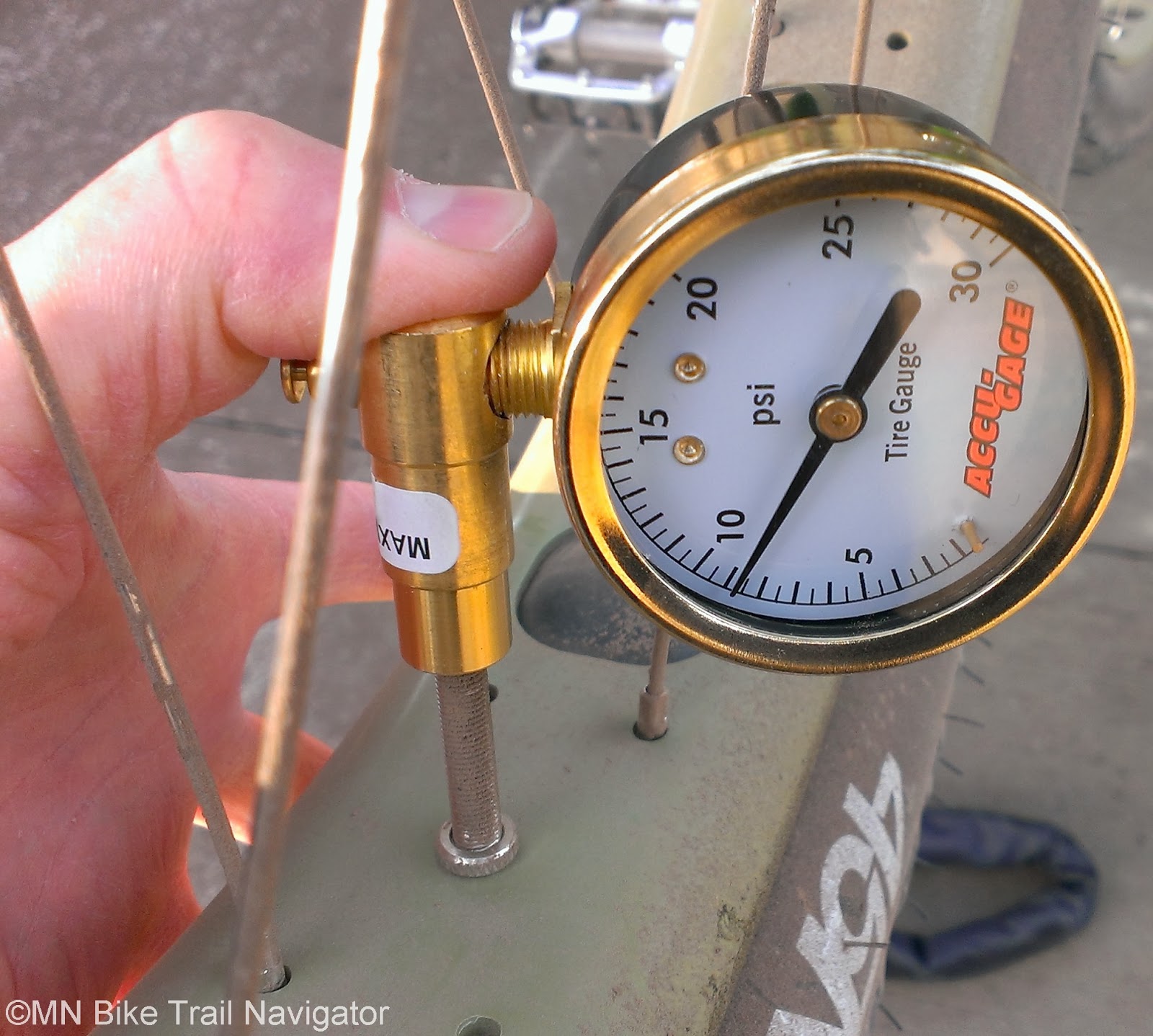
G.H. Meiser & Co. Low Pressure Presta Valve Dial Gauge
$16

When running very low air pressure that fatbike tires are known for, you will want to be able to dial them in to the proper inflation.  G.H. Meiser's Low Pressure Presta Valve Dial Gauge will help do just that.  Whether riding hard-packed singletrack, snow-packed trails or fresh powder, this gauge will make sure you know you are at the right pressure for for the conditions.  Simply press onto the Presta valve and hold until you get a reading and remove.  The needle will indicate the pressure and stay there until the button is pressed resetting it to zero.  Over time you will get a feel for what psi works best for differing conditions.  Available from Penn Cycle, Fatbikes.com and other online retailers.

Bar Mitts
$64.95

Riding fatbikes in winter presents many challenges due to the weather and keeping your fingers warm is one of them.  A set of Bar Mitts greatly improves keeping your hands warm and maintaining finger dexterity for shifting and braking.  Made from Neoprene, they protect from rain, snow, wind and cold.  Installation takes seconds and they can be used with fingered gloves or lobster claws for extra warmth.  Available from Bar Mitts, Penn Cycle and other fine bike shops.

ColdAvenger Pro Softshell
$59.95

The ColdAvenger Pro Softshell half facemask will protect your face and lungs in the most extreme conditions.  It has fleece insulation with a water-repellent/breathable, windproof shell that covers your neck, ears and face.  The ColdAvenger ventilator warms and humidifies cold, dry outside air and does not impede breathing during rigorous activity.  It has been designed to work with goggles and helps prevent fogging when wearing them.  I have spent up to five hours in sub-zero temperatures wearing it and having a cold face and neck was never an issue.  Available from ColdAvenger, REI, Amazon and other online retailers.   

Lone Peak Pfeifferhorn Handle Bar Pack
$39.95

The Pfeifferhorn Handle Bar Pack has 330 cubic inches of storage space with an external pocket for small items.  An internal full length polyethylene stiffener maintains the pack's shape and provides stability.  Its three-point suspension system fits almost any handle bar type.  This pack is a great add-on for carrying gear on longer rides or a spacious alternative to a seat bag.  It comes in handy for carrying a tool kit, gloves, goggles or snacks for out on the trail.  Comes in four colors: Black, Blue, Red, Steel.  Available from Lone Peak and online retailers.

Light & Motion Stella 500
$199

The Stella 500 is a compact, lightweight, high-output LED headlamp with long run times.  Powered by a Li-ion rechargeable battery pack, it has six light modes:  High (500 lumens), Medium (275 lumens), Low (140 lumens), Pulse (140 lumens), RaceHi (500 lumens) and RaceLo (275 lumens) with run times of 2¾ to 12 hours (24 hrs. on Pulse mode).  With power like that, you'll be ready for those long rides between dusk and dawn.  Mounts without tools to your helmet or handle bars and the external battery pack can be placed in a pocket or strapped to your bike frame.  Use the Pulse mode to get you seen in the daytime on snowmobile trails or in town.  Available from Light & Motion, Penn Cycle and online retailers.  

Outdoor Research Crocodile Gaiter
$75

These gaiters are tough.  They have a breathable/waterproof Gore-Tex Nylon upper and a lower panel of Cordura-coated Nylon lined with packcloth.  The two inch wide hook and loop fastener runs the full length of the gaiter to allow it to be easily put on and adjusted to many different boot styles.  The BioThane webbing instep strap keeps them securely in place and the boot lace hook keeps them from shifting.  Designed for snowshoeing, cross county skiing and glacial climbing, they will provide that extra protection needed from the knee down when riding in in wet or snowy conditions.  Available in Men's and Women's sizes from Outdoor Research, REI, Amazon and other online retailers.

Xpedo Face Off 18 Pedal
$99

This low profile, large platform pedal has 20 replaceable pins that provide excellent grip in all weather conditions.  The large openings on each side of the spindle keep snow and ice from building up and interfering with foot to pedal contact.  It has a cromoly spindle with cartridge bearings, DU bushing and a 6061 CNC Aluminum body that weighs in at only 385 grams.  Available in three color choices (Black/Silver, Red/Pearl White, Gold/Navy Blue) and comes with extra pins and wrench.  Available from Xpedo, Penn Cycle (call for availability) and other fine bike shops.
Related Posts Plugin for WordPress, Blogger...